
LOAVES & LONGING
The stranger at the door and the mercy we owe to those we call 'Others.'
12/20/20255 min read
Some years ago, far back in what feels like another life, I once wanted to become a pastor. This was before the old dragon of church hurt wounded me. I was back home in California after years living in the Pacific Northwest, interning at a megachurch on the eastern edge of Los Angeles County.
One Sunday morning, while working the information table in the lobby, a man approached me.
He was Mexican and spoke no English. He appeared disheveled and worn, carrying a visible exhaustion and a quiet sense of hopelessness. I remember thinking that he had recently crossed the border and that, for reasons I never learned, he had found himself standing in that church lobby looking for help.
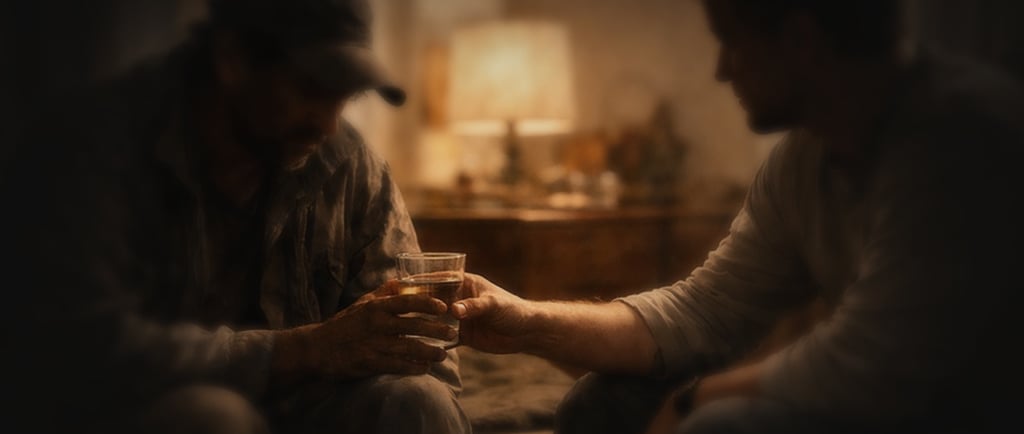
I don’t remember the details of how we communicated through the clumsy language barrier, but I understood one thing clearly. He was hungry. We were between services, so I took him to the volunteer center, sat with him, and brought coffee and donuts. I handed him a donut, and he asked if he could have huevos con frijoles.
He ate very little of the donut, and I tried to communicate that we would go get real food after the next service. He quietly agreed, and together we walked into the sanctuary.
In my naïveté, I believed it would be better for him to attend service despite not understanding English, and if I am honest, I felt that I shouldn’t miss church myself.
As the service progressed, I caught movement from the corner of my eye and I turned just in time to see him slump forward, sliding out of his seat and onto the floor.
Panicked, I waved for help as ushers rushed over while the pastor continued preaching as if nothing had happened. The well-oiled machinery of the sermon rolled smoothly on, and the disruption was hushed and unnoticed by the packed congregation. They managed to get him to his feet and escorted him into the lobby, where medical attention arrived. He had fainted from hypoglycemia after having gone without food for quite some time.
It’s been more than twenty years, and I still think about him. I regret my short sightedness and not seeing his need over what I thought more important for him. I don’t remember his name, and I don’t know where he is now, but I often wonder who he was, what his story might have been, and what drove him to leave his home. I wonder whether he had family who loved him and whether he loved them in return, whether he was kind or broken, or whether he was simply desperate.
Today, contention hangs thick in the air around the topic of illegal immigration, and opinions are often quick, loud, and fierce. And we all recognize how sharply this issue divides us. Beneath the noise, however, lies a deeper question about whether we love freely or whether we compartmentalize our faith for what we call the greater good.
Do we withhold love because it looks weak or foolish, or because we believe it poses a danger to a healthy society?
There is truth in the need for order and balance, yet for the believer, for the one who proclaims a merciful and saving God, the issue runs deeper. It has become far too easy to dismiss people and just as easy to forget their humanity.
From a distance, people become villains, statistics, and talking points rather than men, women, and children with families, worries, joys, and fears. Yet they are us, formed by the very same hands that formed you and I.
It takes only a little leaven to work through the whole loaf, and ideologies thrive on fear of the other, driving wedges even among those who follow Christ. For a moment, maybe we can lay aside the arguments of lawbreaking and political minutiae and look instead at our own hearts, at how easily we dehumanize those who are different from us and how quickly we trade in rumor and stereotype.
As followers of Christ, the question is not merely what our position should be, but how we are called to love those who are already here and living on the margins.
Jesus said that the fullness of the Law and the Prophets is summed up in this: “Love the Lord your God with all your heart and with all your soul and with all your mind, and love your neighbor as yourself.” - Matthew 22:37-39
It’s easy to see people in two dimensions rather than in the fullness of their humanity, and for that reason we should be willing to ask ourselves how many of us truly know an undocumented person, how many of us have entered into relationship with, and how many of us have broken bread and walked alongside someone whose life is shaped by that reality.
Were we to experience this, perhaps we wouldn’t be so ready with our judgements.
As a society, we are quick to leap toward preconceived notions, yet it is only through genuine relationship that we learn to walk in another person’s shoes, and even more so, it is our common life in Christ that levels these assumptions and binds us together. Under this banner Paul reminds us that there is neither Jew nor Gentile, neither slave nor free, nor male nor female, because we are all one in Christ Jesus, as he writes in Galatians 3:28.
I find my thoughts going to the persecuted church in other parts of the world, for whom we grieve when they suffer abuse and torment, yet I wonder whether we have taken into consideration that many of those we dismiss as illegal immigrants share the same love for Jesus and the same faith that we ourselves profess.
When we look online, we encounter video and images of daughters crying as their mothers are thrown to the ground, shackled, and forced into unmarked vehicles, of men being chased down and assaulted, and of small children suffering terror in these moments that will scar their young psyches for life.
Having seen these things, I am left wondering about our silence in the face of such cruelty and whether we have become so entangled in our ideologies that we explain these moments away as being staged or we engage in ‘whataboutisms’, simply because they challenge the systems we feel compelled to defend.
Whatever our politics may be, whether we lean to the right or the left, conservative or liberal, the one thing that binds faith together is our hope, our unity in Christ Jesus, in whom there is no room for petty factions or strife but only the wholeness and peace of His Spirit.
He has appointed us as ambassadors of an upside down kingdom that honors humility and brokenness, lifts up the dismissed and the crushed, and makes all things new, and we demonstrate our devotion to God by loving the one we are tempted to call the ‘other.’
As the church, we are called to stand with the weak and the broken no matter who they are, just as the prophet cried aloud in Isaiah 1:17, rather than anchoring our hearts in divisive rhetoric, we are invited to live differently.
God draws diverse peoples to Himself through surrendered hearts that see beyond affiliations and beyond what any party declares to be right or virtuous, and we are called to be separate not from the world itself but from the broken systems within it, becoming all things to all people so that some might come to know the good and humble hand of Christ.
In this season, as we celebrate the birth of the One who brings peace and life into the world, let us set aside condemnation, partisan judgment, and the habits of division, choosing instead to look again with fresh eyes, His eyes, and to see anew with compassion, true justice, and mercy during this holiday in which we celebrate our Emmanuel, ‘God with us.’