THE LION IS THE LAMB
God’s path to triumph is the way of the crucified Lamb
3/10/20264 min read
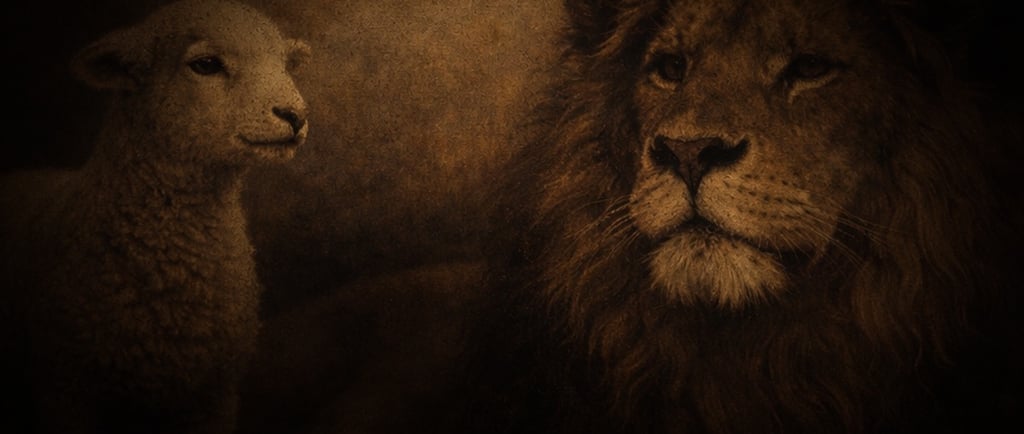
And I looked and “Then I saw a mighty angel proclaim in a loud voice, ‘Who is worthy to break the seals and open the scroll?’ But no one in heaven or on earth could open the scroll or look inside of it.” I wept and wept because no one was found who was worthy to open the scroll or look inside. Then one of the elders said to me, “Do not weep! See, the Lion of the tribe of Judah, the Root of David, has triumphed.” - Revelation 5:6-9
My days lately have been a whirlwind. Demands of my business had pulled me into many different directions, and truthfully, I needed to step back from the pen and find perspective once more. The itch though, cannot be suppressed for long.
Even in busyness and the rush of life, I have watched the world unfold. I see the threat of war, the industry of war, and the tireless justifications for war. I have seen the name of God brandished as a justifier, a holy means to violent choices. Many speak about these days being the steps towards end times. They pour over prophecy and search out books like Revelation for hints and knowledge of things to come.
I myself have thought about the book of Revelation, more so Revelation, Chapter 5.
Here we find John the Revelator standing in the throne room of heaven. He has been whisked out of exile from the island of Patmos and into the realm of the Holy One to witness human history played out.
After watching the worship of the angelic creatures and elders John looks and sees a scroll in the right hand of God. This scroll is a symbol of God’s sovereign plan for redemption and purposes far exceeding our own limited means of discernment. The scroll is a symbol of hope and a glimpse into the mysteries of another kingdom. An angel then cries out, “Who is worthy to break the seals and open the scroll?”
Silence.
None in heaven, none on earth, or under the earth are found worthy to unlock the purposes of God. John begins weeping. And his was a weeping lain in hope bereft; a sorrow of turmoil and brokenness. For if the scroll remains closed, there is no redemption to be had and all would be lost. But as he wept, an elder spoke to him: “Do not weep! See, the Lion of the tribe of Judah has triumphed. He is able to open the scroll.” Yet, when John turns to see this Lion, he sees something else entirely. He sees not a Lion, but a Lamb. - Revelation 5:5-6
Too often, the Lion and the Lamb imagery has been confused, we believe that Jesus was a lamb during his first coming and will only be a Lion upon his return. We are taught that God works through the powers of strength and the conquering of foes, but Revelation does not say that He is sometimes a lion and sometimes a lamb, He is both at once, the Lion whose authority is found in His sacrifice, and the Lamb whose sacrifice anchors His victory. His are the ways of the upside down Kingdom from that which the prideful scoff.
Interestingly in Revelation 19, we see Christ seated atop a horse wearing a robe dipped in blood, which can be viewed as conquering through violence. He goes to battle against His enemies, but He comes not with spear or battle axe but with the ‘sword of His mouth’, His word, signaling conquest not by the type of militaristic force men expect but by truth. And following Him are His armies dressed not in battle armor, but in unblemished, white linen, acting as witnesses to a warfare they carry no sword and wear no armor for. They themselves conquer through their testimony and His sacrifice, participating in a triumph that has already been secured.
Revelation 5 declares that God’s path to triumph is the way of the crucified Lamb. We often view this book through a lens that merely affirms our own desires for the end of the age; however, we are called to see it as a catalyst for spiritual growth. By embracing the Lamb’s perspective, we learn His humility and His true nature.
Here the Lion is revealed as the conquering Messiah, ultimately subduing not through military might, but through sacrificial love of the cross, which proves He is the only authority to bring about God’s purposes at the end of all things.
Yet, the world of bent power and its spokesmen will say that we live in a world that is governed by strength, that is governed by force, that is governed by power and that God also comes in the same way. This is celebrated as the means to an end but the Lion Who Is The Lamb and Who Was Slain - Isaiah 53:7, His testimony says otherwise.
As men and women called to be the revelators of the Christ and of a kingdom that exists upside down from any worldly power, let us be witnesses of the Lion who is truly the Lamb who was slain. Not witnesses to any justifications of warring and taking His holy name in vain for the means of the expansions of earthly kingdoms.
And as witnesses to a dying world, let us be a church rooted not in strongmen but a church anchored in the throne room vision of Revelation Five. A vision of a mighty Lion who is fierce and all justice, but who has subverted our desire for blood not with the blood of enemies but by His own shed blood that both redeems and transforms hearts from hardened stone to hearts of flesh.
So, let us not be lured into the pursuit of power or any of its justifications. Instead, let us rest in our weaknesses and His ultimate authority, which is a strength that contradicts everything fading men declare about winning.
For the fierce Lion of the tribe of Judah is, eternally, the same Lamb who was slain. He is the mighty Lion who still bears the wounds of humility as the enduring symbol of His kingdom, a realm unlike the dying empires of men that tout pride and self-reliance. He reigns unopposed, yet remains humble-hearted, merciful, and peaceful. He is not a mere warrior king, but the Lion who is also the Lamb, the One who conquered by Himself being slain.